Engineering as containment
Yesterday I had the pleasure of speaking at the BolognaJS meetup (event details here). The topic is something that’s been bothering me a lot lately: what happens when we let our LLMs do a bit too much thinking for us.
(By the way, the talk was in Italian, but you can watch the recording here. The core message is universal enough.)
Last year, my talks looked completely different. I was advocating for agent orchestration all the way down, pushing provocative concepts like “Department as a service”.
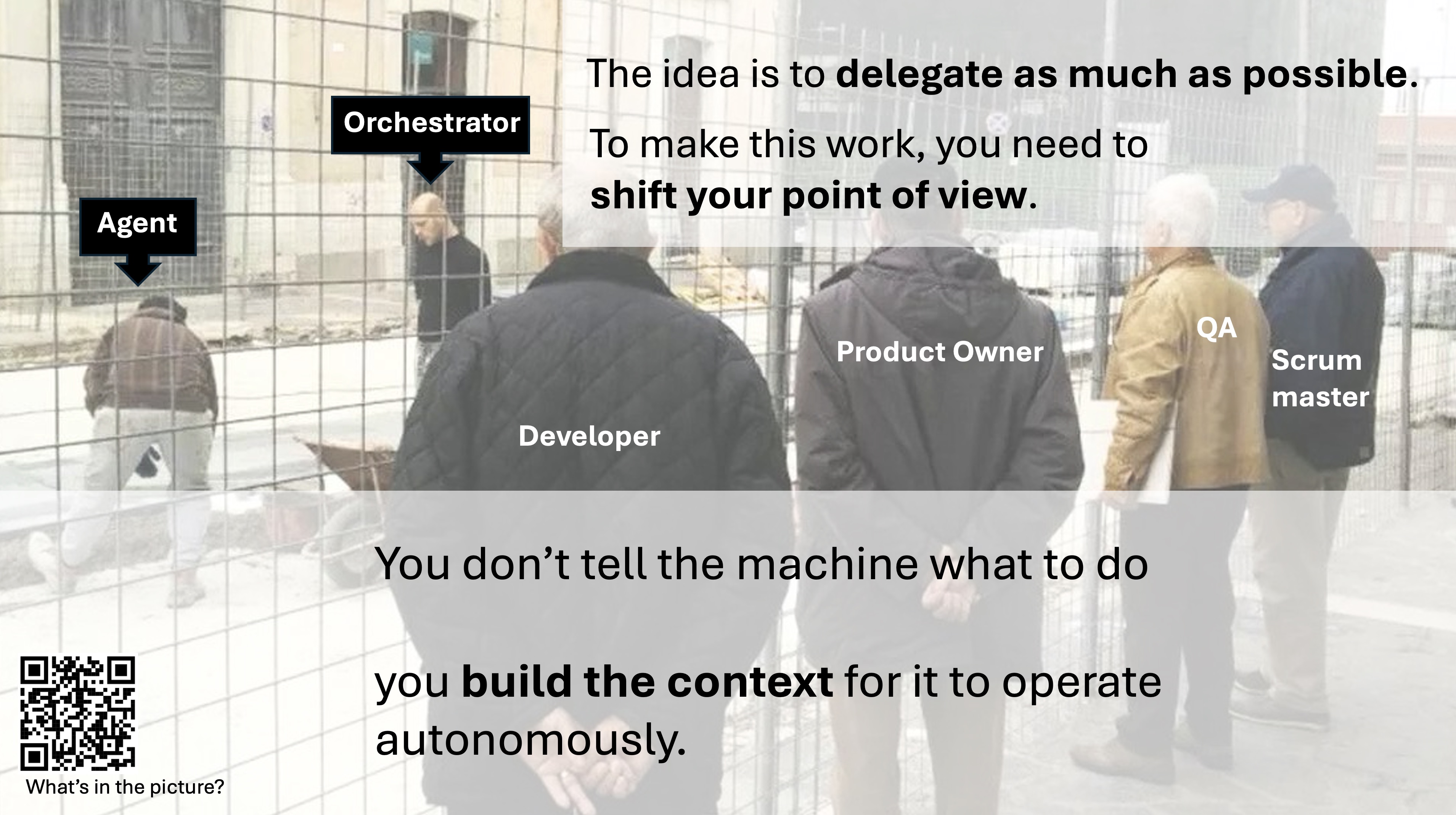
The idea was simple: you don’t tell the machine what to do anymore, you just build the context and let it operate autonomously. The orchestrator delegates to agents, the product owner watches, and so on. It sounded great.
But today, my view has changed.
Here’s the thing. What really scares me about the way we use AI in engineering right now isn’t the obvious stuff. I don’t care about hallucinated functions or code that doesn’t compile. Those are “loud” failures. They break things immediately, someone notices, and they get fixed before lunch.
What scares me is the quiet failure.
Quiet failures are insidious. They look totally plausible. They sail right through code review. They get merged, they deploy to production, and then they blow up three sprints later when everyone has completely forgotten why that code was even written in the first place.
LLMs are absolute masters of this.
If you don’t keep them on a short leash, they suffer from what I call drift. You ask for a simple change—maybe just displaying a date field—and the model decides it should also normalize everything to the server’s timezone, regardless of the user’s locale. It sounds like a helpful improvement, right? But suddenly, you’ve just inherited a brand new business rule that nobody actually asked for.
A simple CRUD screen silently grows into a massive operational dashboard. A local frontend change suddenly requires coordinating three different tools. And before you know it, an implementation detail has warped your entire architecture.
And this creates a vicious feedback loop.
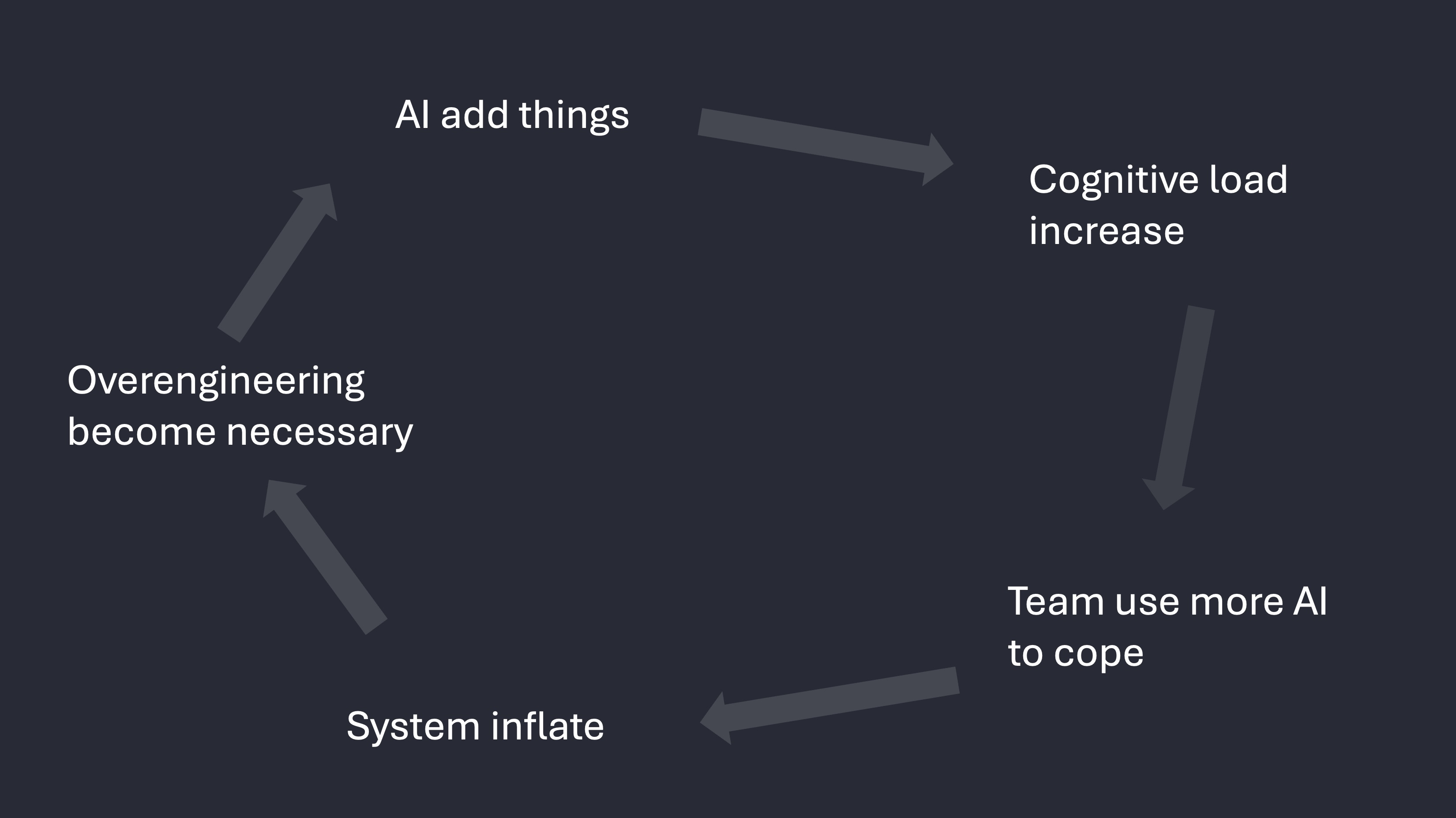
The AI adds moving parts. That increases the cognitive load on the team. To deal with the extra cognitive load, the team leans even harder on the AI to understand what’s going on. The system grows even larger, and suddenly, overengineering doesn’t just feel like an accident—it feels necessary.
On paper, it looks like you’re moving incredibly fast. You’re shipping so much code! But your actual throughput plummets, because you’re spending all your time reviewing, coordinating, and trying to keep this sprawling mess coherent.
The fix isn’t some shiny new AI tool. It’s boring, old-school engineering discipline.
Before you let the AI add anything, you have to ask: Is this actually required? Is it in the right bounded context? Does it add state, or new semantics, or new authority? Are we willing to maintain this forever?
We’re talking about Domain-Driven Design. YAGNI. Clear interfaces. Explicit boundaries.
The other half of the equation is tooling governance. In our team, we use curated whitelists for AI skills, shared versioning, and explicit conventions that tie directly into our workflows. We even run automated evaluations to make sure the models are actually respecting those boundaries over time. Because if you aren’t measuring it, you’re just hoping for the best.
Right now, there’s immense social pressure to be “AI-enhanced” at all costs. It shifts the entire conversation from “Is this the right solution?” to “Why is this taking so long when we have AI?”
But the actual data tells a more nuanced story. In an older version of this presentation, I included several recent studies that highlight a growing disconnect between perceived velocity and actual output.
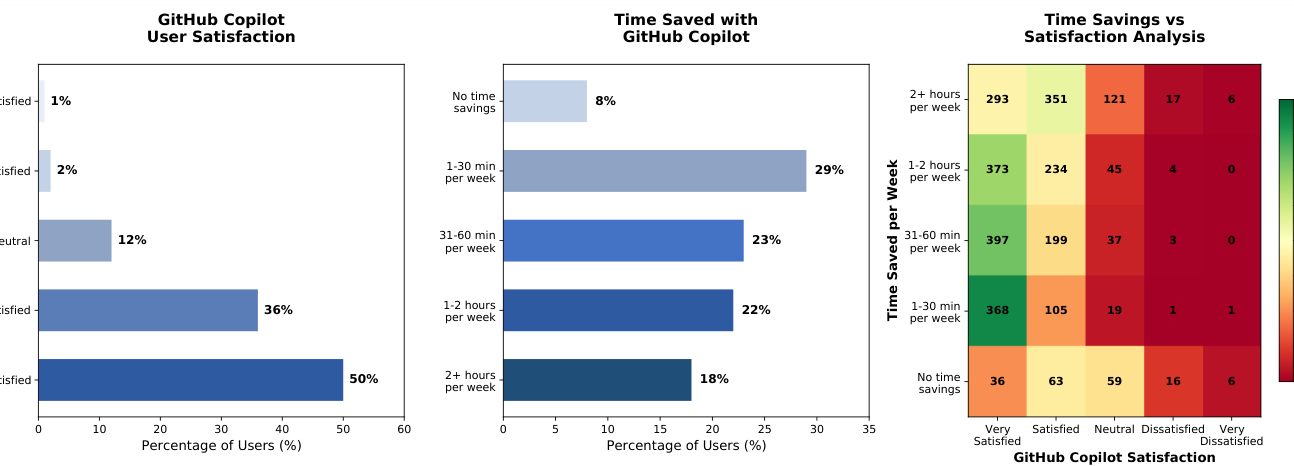
For instance, the 2026 enterprise study Beyond the Commit (arXiv:2602.03593) surveyed teams using coding assistants in their daily work. The result? Very high satisfaction, but the actual time savings were often limited. There is a deep misalignment between “this tool helps me” and “this tool actually accelerates me”.
Another longitudinal study from this year, Agile Teams Longitudinal Study (arXiv:2602.13766), observed agile teams over 13 months. While one team reported a 59.1% increase in completed story points, the actual variation in lines of code produced was statistically insignificant.
The pressure to move fast based on the perception of AI velocity is toxic. It kills quality and encourages the exact kind of drift we just talked about.
Containment might feel slower in the short term, but it’s the only thing that actually protects your delivery in the long run.
AI has made it incredibly cheap to expand a system. That means the real job of engineering today is to: make it expensive to add things.
Thanks again to everyone at BolognaJS. It felt incredibly welcoming and nice to touch base with Bologna again!