How to ship code fast with AI without paying for it later
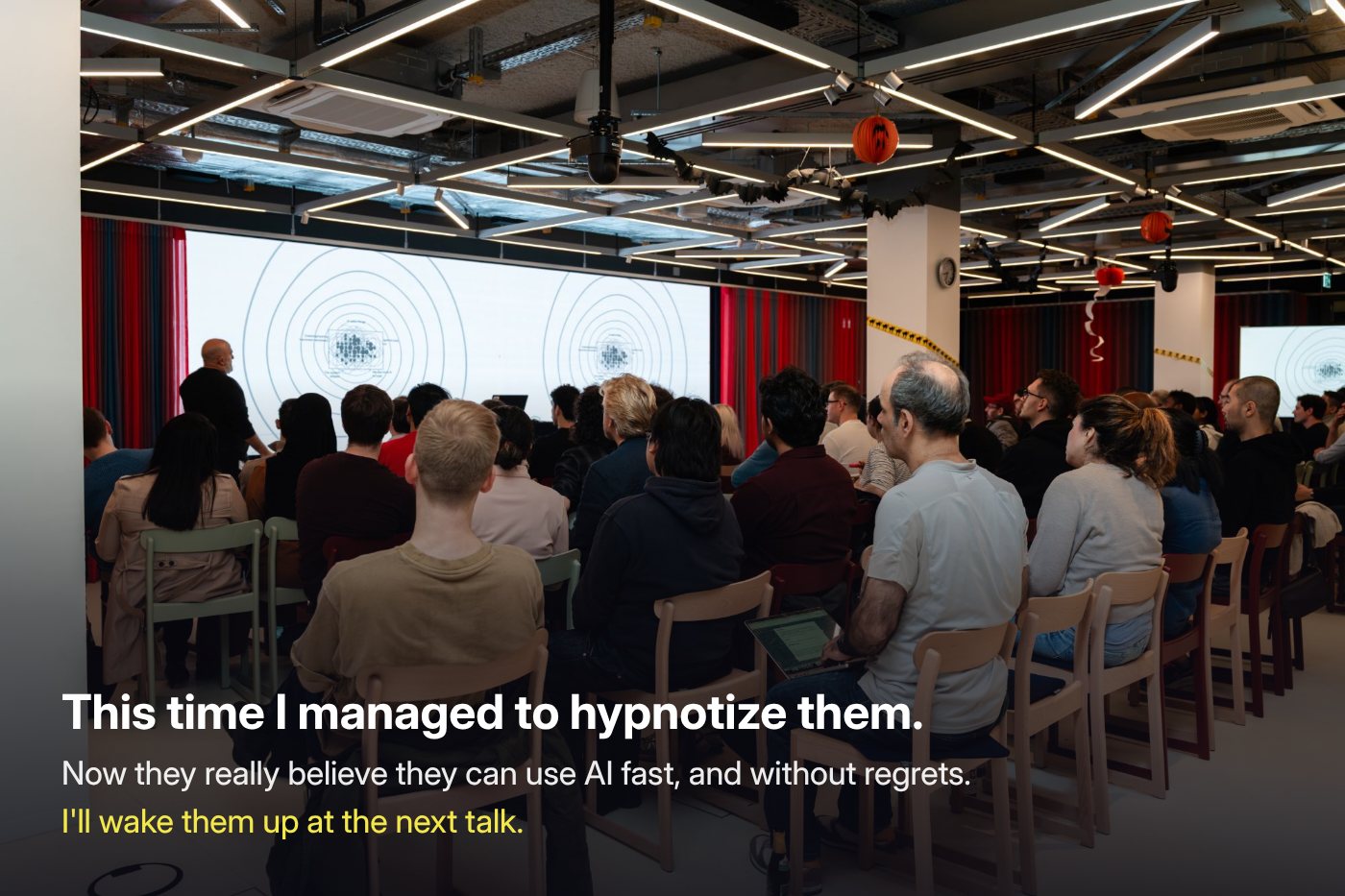
On 22 October I gave the keynote at buildersklub, at the Deutsche Bank Berlin Technology Centre. It was the fourth edition of Engineering as containment.
The hardest part to prepare was the title. I wanted something a bit provocative, and I went through a lot of them. This is more or less how it went, as I showed it on stage:
I settled on the last one because it was the cheekiest of them all: unrealistic, clickbait, grotesque enough that nothing could beat it. Ship fast, with AI, and never pay for it? Sure.
It was also a challenge, because you actually can do something about it: go a bit faster, and regret a bit less. So I kept it, and spent 45 minutes correcting it.
The biggest problem is not the tooling. It’s on the human side: our attention span, and our tendency to drift away from what we meant to do.
That’s the good and the bad at the same time, because drifting is also where creativity thrives. The trick is to know where you are drifting. Drifting at home is not the same as drifting in a regulated environment. You can still do it there, but on purpose: not by mistake, and surely not because a machine suggests more complexity just because it can, and because today it’s cheap.
From there the talk went looking for answers. We talked about tooling and governance, about attention span, and about context, with OKF and OpenSpec. I won’t spoil all of it here, just a taste:
And in the end, it turns out we can unstrike the title. Somehow, and with realistic expectations: How to ship code fast with AI without paying for it later. After all, it’s possible to be a bit faster, and to have fewer regrets.
Every link from the talk
In the order it came up.
Where the time goes
- If you thought the speed of writing code was your problem, you have bigger problems, Andrew Murphy. The pipeline behind the bottleneck: widen one stage and the queue moves to the next.
Stack the great filters
- Retort, Adrian Cockcroft. Compares tooling stacks across models and environments, baseline against candidate, to decide what to promote or retire.
- promptfoo. Tests prompts, models and agents against your own cases, so a change to your agents can be checked before it ships.
Governance
- skills.sh. The public skills registry our own is a fork of, with trusted sources only.
- Angular skills. Angular’s own skills for coding agents.
- mattpocock/skills. Matt Pocock’s skills, from his own agents directory.
Keep it in a human head
- Why is it so hard to do my work? The challenge of attention residue when switching between work tasks, Sophie Leroy, 2009. When you switch tasks, part of your attention stays on the one you left.
- Executive control of cognitive processes in task switching, Joshua Rubinstein, David Meyer and Jeffrey Evans, 2001. Every switch costs time, and the cost grows with the complexity of the tasks.
- Measuring the impact of early-2025 AI on experienced open-source developer productivity, METR, 2025. Experienced developers with AI tools felt about 20% faster and were 19% slower. 16 developers, 246 tasks: read the authors’ caveats before generalising.
- How AI assistance impacts the formation of coding skills, Anthropic, 2026. Developers who kept asking conceptual questions learned more than those who handed the code over.
Write down what we know
- Open Knowledge Format (OKF), spec v0.2, Google Cloud. Plain markdown in git, where every page says who wrote it and who vouched for it.
- OpenSpec, Fission AI. Every change is proposed before it lands.
Tomorrow
- Redesigning source control at Anthropic, Anthropic Engineering, 13 October 2026. What happens when coding stops being the bottleneck, and why the engineers’ job becomes saying no.
- Build your own AI software factory with Claude Code, ZazenCodes, 7 October 2026. A small factory you can run today (source code).
Thanks
- Brian Rigoni and Abdel Fortas, for the skills.
- Paul Vitic, for the curated brain close to the code.
- Claudio Cicali, for reviewing the talk.